
Home / Health Articles / Diabetic Care
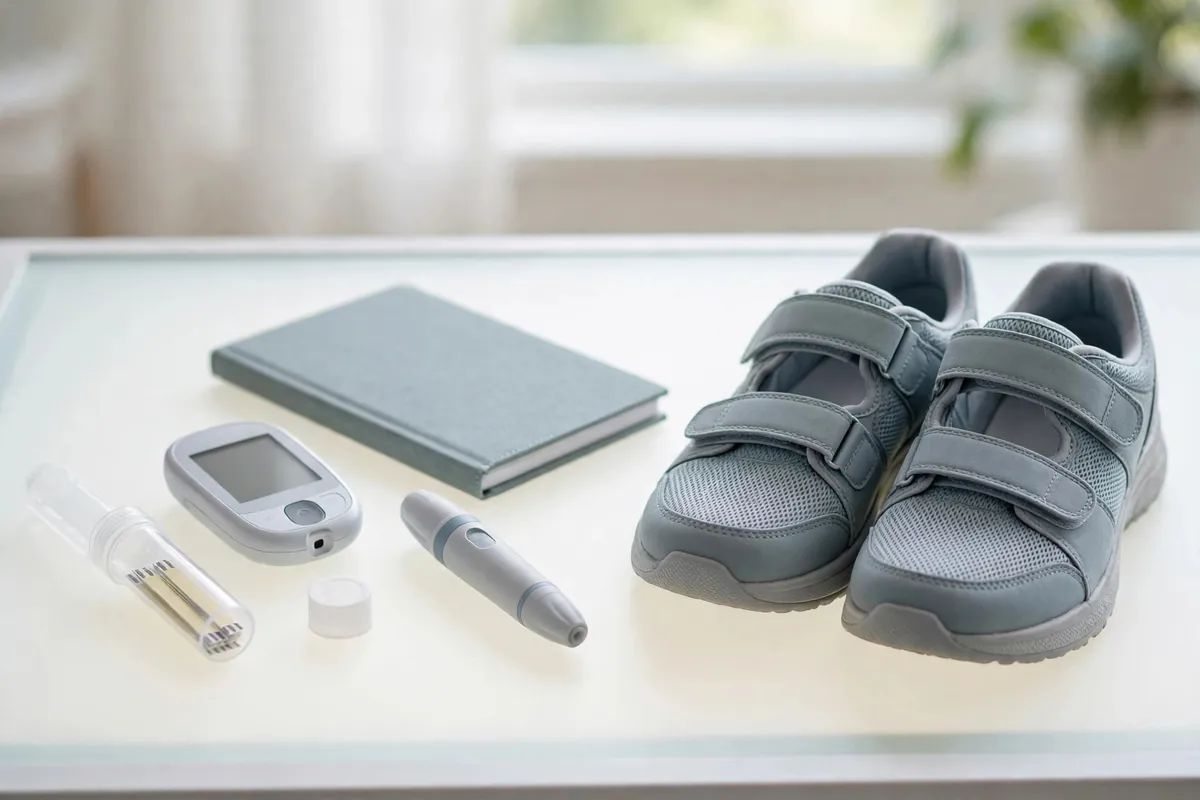
Diabetic testing supplies are the friendliest corner of Medicare’s equipment benefit. The prices are set nationally — a box of 50 test strips has the same Medicare-approved amount, $8.32, in every state — and nearly half of the suppliers who provide them accept assignment, the highest rate of any major category in this directory.
What decides your cost is not where you live but how much you use: Medicare sets quantity limits that depend on whether you treat your diabetes with insulin. This guide gives the amounts, the limits, and the monthly arithmetic for both cases.
Contents
- What Medicare allows for the supplies
- The quantity limits: insulin makes the difference
- What you pay each month: two worked examples
- Mail order or local supplier?
- Diabetic shoes are a separate benefit
- A note on continuous glucose monitors
- Finding a supplier
- Common questions
What Medicare allows for the supplies
Glucose testing supplies sit in Medicare’s “usually purchased” class — bought outright, not rented (see how Medicare’s payment classes work). The fee-schedule amounts are national:
| Item | Code | Medicare allows | Your 20%, if assigned |
|---|---|---|---|
| Blood glucose test strips, box of 50 | A4253 | $8.32 | $1.66 |
| Lancets, per box | A4259 | $1.42 | $0.28 |
| Calibrator solution / control chips | A4256 | $3.38 | $0.68 |
| Home blood glucose monitor | E0607 | $9.52 in most states | $1.90 |
Amounts from the CMS DMEPOS fee schedule, Blood Glucose Monitors/Supplies categories, November 2026. The monitor amount varies slightly by state ($9.52–$10.87); the supply amounts above are the same in all states in the current schedule.
Two things follow from the table. First, brand does not change the amount: Medicare pays the fee-schedule figure whatever brand of strips your meter uses, which is why suppliers may stock a limited range of brands. Second, at these unit prices the 80/20 split is small in absolute terms — the real questions are quantity and billing, not price shopping.
The quantity limits: insulin makes the difference
Medicare covers testing supplies up to standard quantities that depend on your treatment:
- If you use insulin: up to 100 test strips and 100 lancets per month.
- If you do not use insulin: up to 50 test strips and 50 lancets every three months.
More than the standard quantity can be covered when your clinician documents why the extra testing is medically necessary — for example, unstable control or frequent low blood sugar — and you keep the testing log your supplier may ask for. Quantities above the limits without that documentation are the ones Medicare denies, and a supplier who ships them anyway may leave you with the bill; a supplier may ask you to sign an Advance Beneficiary Notice (ABN) if it expects a denial, which is your warning to sort the paperwork first.
What you pay each month: two worked examples
Testing daily, not using insulin. Fifty strips every three months is one box of A4253 per quarter: $8.32 of approved charges, of which your 20% is $1.66 per quarter once the deductible is met — under a dollar a month, with an assigned supplier.
Testing twice a day, using insulin. Two boxes of strips a month is $16.64, plus lancets; your 20% comes to roughly $3.50 a month with an assigned supplier. Even at the maximum standard quantity, diabetic supplies are among the cheapest ongoing costs in this directory — provided the claim is billed to Medicare rather than paid at a pharmacy till at retail prices, which are typically several times the fee-schedule amounts.
Mail order or local supplier?
Medicare enrols glucose-supply providers in two categories — mail order and non-mail order — and this directory counts 38,614 suppliers in the non-mail-order category alone. The fee-schedule amounts are the same either way. Mail order suits a stable routine; a local supplier suits anyone who wants to sort a meter problem in person. In both cases the checks are the same: enrolled for glucose supplies, and — for the cleanest billing — accepting assignment, as 47.9% of these suppliers do.
Diabetic shoes are a separate benefit
Do not confuse testing supplies with therapeutic shoes, which are a distinct benefit with its own rules. If you have diabetes with qualifying foot conditions, Medicare covers, per calendar year, one pair of custom-moulded or extra-depth shoes and three pairs of inserts, prescribed and fitted through enrolled suppliers. The suppliers appear in this directory under their own categories (Diabetic Shoes and Inserts); the testing-supplies counts above do not include them.
A note on continuous glucose monitors
Continuous glucose monitors (CGMs) are covered under the same durable-equipment benefit for people who use insulin or have a history of problematic low blood sugar, with their own coverage criteria and billing codes. They are not priced from the supply amounts in the table above. If your clinician suggests a CGM, the supplier will confirm eligibility against the current criteria before shipping — ask them to do that check, and to tell you your monthly share for the sensors, before you commit.
Finding a supplier
The MedicineContact directory lists 38,614 suppliers enrolled to provide blood glucose monitors and testing supplies. The largest numbers are in Texas (3,311 suppliers), California (3,013 suppliers), Florida (2,995 suppliers), New York (2,469 suppliers), Illinois (1,533 suppliers), Ohio (1,442 suppliers), Pennsylvania (1,400 suppliers) and North Carolina (1,353 suppliers) — or browse all 50 states. City pages narrow it further: Houston, for example, or Los Angeles.
On each listing you can see whether the supplier accepts assignment — for blood glucose monitors and testing supplies, 18,479 of the 38,614 suppliers in the directory do, about 48% — the Medicare-allowed amounts for your state, and reviews from other patients. Confirm the assignment status and your expected cost before any equipment is shipped.
Common questions
Does Medicare cover test strips if I do not use insulin?
Yes — at the lower standard quantity: up to 50 strips and 50 lancets every three months, provided your clinician has ordered the testing and the diagnosis supports it.
Can I get my supplies at my local pharmacy?
Yes, if the pharmacy is enrolled with Medicare as a supplier for these items — many are. If it is not enrolled and you pay retail, Medicare will not reimburse the purchase afterwards. Ask at the counter before handing over money: “Are you enrolled to bill Medicare for diabetic supplies?”
My supplier wants to ship three months at once. Is that normal?
Supplies are commonly shipped monthly or quarterly within the quantity limits. What matters is that shipments match the limits for your treatment and stop if your treatment changes — tell the supplier if it does, so you are not billed for unneeded stock.
Does Medicare pay for the brand my doctor specified?
Medicare pays the same fee amount for any brand. If the specified brand matters clinically, your clinician can document why; otherwise expect the supplier to offer the brands it stocks at that amount.
References
- CMS DMEPOS Fee Schedule, “Blood Glucose Monitors/Supplies” fee categories (codes A4253, A4259, A4256, E0607), as extracted from the MedicineContact database, November 6, 2026.
- Medicare.gov, “Diabetes supplies & services” and “Therapeutic shoes & inserts” — medicare.gov.
- Supplier counts and assignment status: CMS DMEPOS enrollment data as published in the MedicineContact directory, November 2026 (38,614 non-mail-order glucose suppliers; 18,479 accept assignment).
This guide is general information about Medicare coverage and costs, not medical advice and not a coverage decision for any individual. Fee-schedule amounts are those published by CMS and change periodically; suppliers’ own charges may differ. Confirm your coverage and expected costs with your supplier and with Medicare at 1-800-MEDICARE (1-800-633-4227) or Medicare.gov before ordering equipment. MedicineContact is an independent directory of Medicare-enrolled suppliers. It is not affiliated with Medicare, CMS, or any government agency, and listing a supplier here is not an endorsement of that supplier.